Why office cleanliness matters more than it might seem
It's easy to treat office cleaning as an administrative detail — something that happens in the background and gets noticed only when it fails. In practice, the cleanliness of a working environment has a more significant effect on the people in it than is often acknowledged.
Research on workplace environments consistently finds that physical surroundings affect concentration, mood, and stress levels. A cluttered, dirty, or neglected office creates a kind of low-level background stress that people often don't consciously identify but that nonetheless affects how they feel about coming to work. Conversely, a clean, well-maintained space signals to staff that their working environment is valued.
There's also the practical issue of hygiene. Office environments — particularly those with shared surfaces, kitchens, and toilets — are well-established vectors for the spread of common illnesses. Desks, keyboards, door handles, and kitchen equipment harbour bacteria at levels that are frequently cited in environmental health studies. Regular, thorough cleaning of these surfaces reduces the burden of illness-related absences in a way that's difficult to quantify precisely but is real.
For any business that receives clients or visitors, the state of the premises also affects how the company is perceived. A clean, well-maintained reception, meeting room, and toilet sends a message about standards and attention to detail. A neglected one sends the opposite message.
The areas that need the most attention
Not every part of an office requires the same level of cleaning frequency or effort. Understanding which areas carry the highest risk or create the most visible impact helps in prioritising resources effectively.
Kitchens and break rooms
The office kitchen is among the most used and most frequently neglected spaces in a workplace. It's used by everyone, maintained by no one in particular, and tends to accumulate mess through a combination of high usage and diffuse responsibility. Microwave interiors, kettle scale, fridge contents, sink drainage, and surface detritus from multiple daily uses can deteriorate very quickly without regular attention.
The kitchen also carries the most significant hygiene implications — food preparation surfaces and shared appliances are among the most effective vectors for spreading bacteria in an office environment. A standard of cleaning adequate for a domestic kitchen isn't always sufficient for a space used by ten, twenty, or fifty people.
Toilets and washrooms
The condition of a workplace's toilets is probably the single most noticed indicator of overall cleanliness standards, both by staff and visitors. Sanitary standards in washrooms need to be maintained consistently and not just periodically — once a week is rarely sufficient in an actively used office. Daily attention is a baseline for most busy workplaces; twice daily may be warranted in larger spaces.
Workstations and shared surfaces
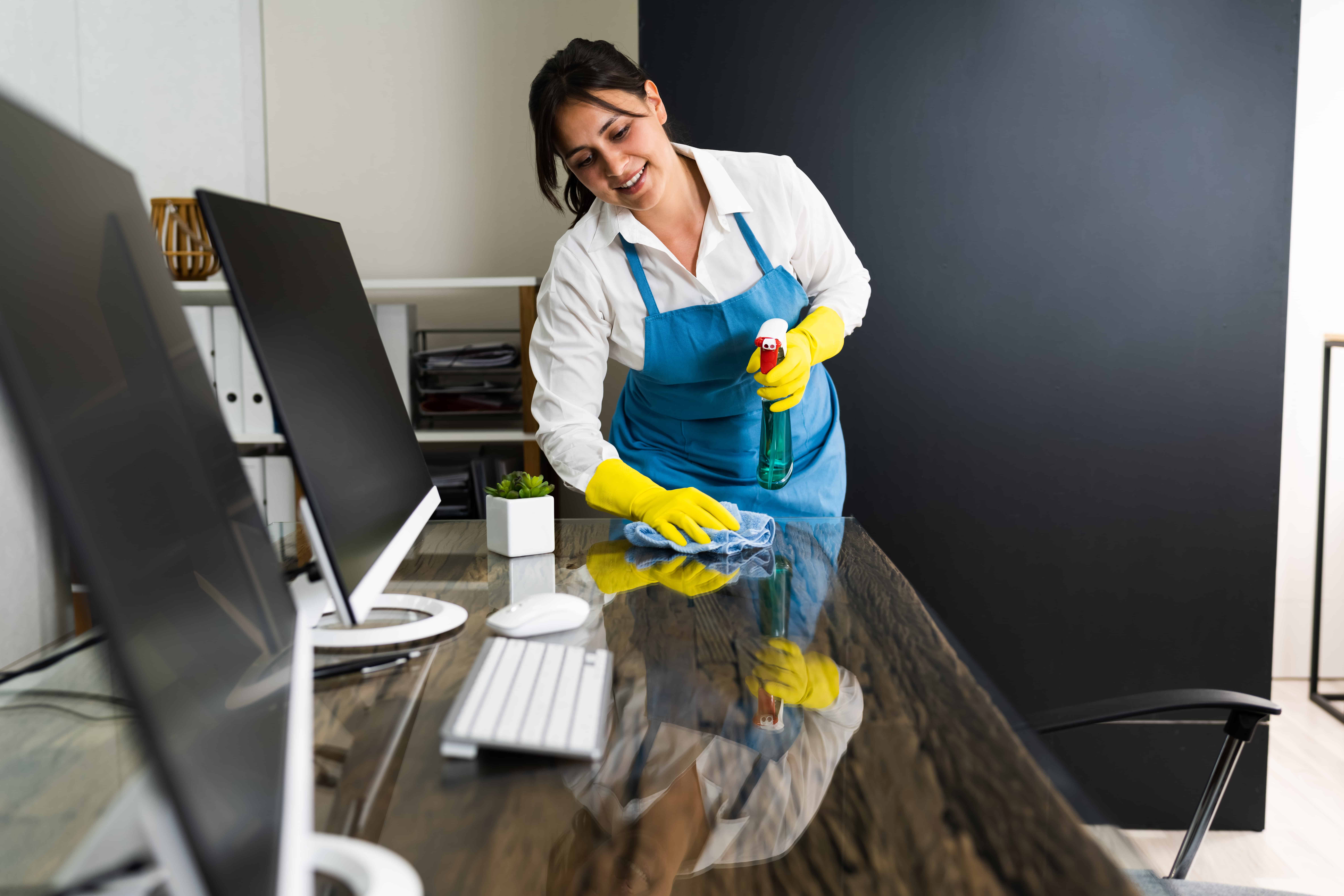
Individual desks, shared work surfaces, meeting room tables, and reception areas need regular wiping down to address the accumulation of dust, food particles, and bacteria from regular use. Keyboards and telephone handsets are among the most bacteria-laden surfaces in a typical office environment and are often overlooked in cleaning routines.
In hot-desk environments, where multiple people use the same workstations on different days, the case for regular surface cleaning is stronger still. A clear desk policy makes this significantly easier to implement in practice.
Floors and entrances
Entrance areas and high-traffic floor zones pick up dirt quickly, particularly in autumn and winter when people track in mud, water, and debris from outside. These areas make a first impression on everyone who enters the building. Carpet in high-traffic areas needs vacuuming more frequently than desks or partitioned areas; hard floors in entrances may need mopping daily in poor weather.
Setting up an effective cleaning schedule
A practical office cleaning schedule needs to be realistic about what frequency of cleaning different areas actually require, and honest about what a single weekly visit can and cannot achieve.
For most offices, the following breakdown is a reasonable starting point:
- Daily: Toilets, kitchen surfaces and sink, entrance floors, emptying bins, wiping down shared surfaces and reception areas
- Three times per week: Full vacuuming, hard floor mopping, wipe-down of workstations and shared equipment
- Weekly: Inside microwave and appliances, thorough bathroom clean, skirting boards and door frames, dusting of shelves and equipment
- Monthly: Inside fridge, upholstery vacuuming, window sills, air vents, behind and under furniture
- Periodically: Carpet deep-clean, window cleaning (internal and external), full kitchen appliance clean, specialist treatments
The right frequency for each category depends on the size of the office, the number of staff, the nature of the work being done, and whether clients visit the premises. An office with a small team working primarily at fixed desks has different needs from a busy client-facing space with regular visitors.
The relationship between staff behaviour and cleaning
Professional cleaning can only maintain a workplace to a certain standard if staff behaviour doesn't constantly undermine it. This isn't about placing the burden on staff — it's about recognising that cleaning is a shared responsibility, even when the physical work is done by a professional service.
The areas where staff behaviour makes the most practical difference:
- The kitchen. Clear agreements about washing up, wiping spills, clearing the fridge of personal items, and not leaving food out go a long way. These don't need to be draconian rules — a shared understanding of basic standards is usually sufficient.
- Desk space. Cleaners can't effectively clean workstations that are buried under papers, cups, and equipment. Even a minimal clear desk expectation at the end of the day makes cleaning significantly more effective.
- Bins. Overflowing bins that aren't emptied between cleaning visits create unnecessary mess. A sufficient number of waste bins distributed sensibly throughout the office, with bin liners changed regularly, prevents this.
"A clean working environment signals to staff that their surroundings are valued. The effect on morale is real, even if it's hard to quantify."
Working effectively with a cleaning contractor
The relationship between a business and its cleaning contractor works best when expectations are clearly defined from the outset and managed consistently over time. Common sources of dissatisfaction in commercial cleaning relationships usually come down to one of three things: unclear scope (both parties had different ideas about what was included), inconsistent quality (cleaning that varies significantly from visit to visit), or poor communication (problems not raised and addressed promptly).
Things worth clarifying before starting a commercial cleaning contract:
- Exactly which areas are included in the scope, and which are excluded
- What frequency different areas are cleaned at
- Who supplies consumables (bin liners, toilet paper, soap)
- How access is handled and what the procedure is if access fails
- What the process is for raising a complaint or flagging a problem
- What happens if a visit is missed at short notice
Once the arrangement is running, a periodic review — every few months — is a sensible habit. Needs change over time: the office grows, hours change, new areas are added. What was the right scope at the start may need adjustment six months in.
The cost of inadequate cleaning
It's worth being direct about the consequences of inadequate workplace cleaning, because the tendency is to treat it as a low-priority line item that can be reduced when budgets are under pressure.
The costs of inadequate cleaning are less visible but real. Increased sick days due to higher illness transmission rates. Staff dissatisfaction and reduced morale in a visibly neglected environment. Negative impressions on clients and visitors. In some sectors, potential compliance issues with health and safety regulations that require workplace hygiene standards to be maintained.
Against these costs, the cost of adequate professional cleaning looks rather different. For most small to medium offices, professional cleaning is not an expensive line item relative to other operating costs. The question isn't usually whether you can afford it — it's whether you can afford the consequences of the alternative.
Practical steps for office managers
If you're responsible for managing office cleanliness and want to improve the current standard, a reasonable starting point is:
- Walk through the office with fresh eyes and note the areas that are most obviously below standard
- Assess whether the current cleaning frequency and scope matches actual usage
- If using a contractor, have a direct conversation about quality — what's working, what isn't, and what needs to change
- If not using a contractor, cost up what professional cleaning would actually represent as a proportion of your overall operating budget
- Establish (or revisit) any shared agreements with staff about kitchen and desk standards
- Set a periodic review date so the arrangement is reassessed regularly rather than drifting
None of this is complicated, and most of it takes very little time. A workplace that's consistently clean is one less thing for everyone to manage, and one more reason for staff to feel that the environment they work in has been thoughtfully maintained.