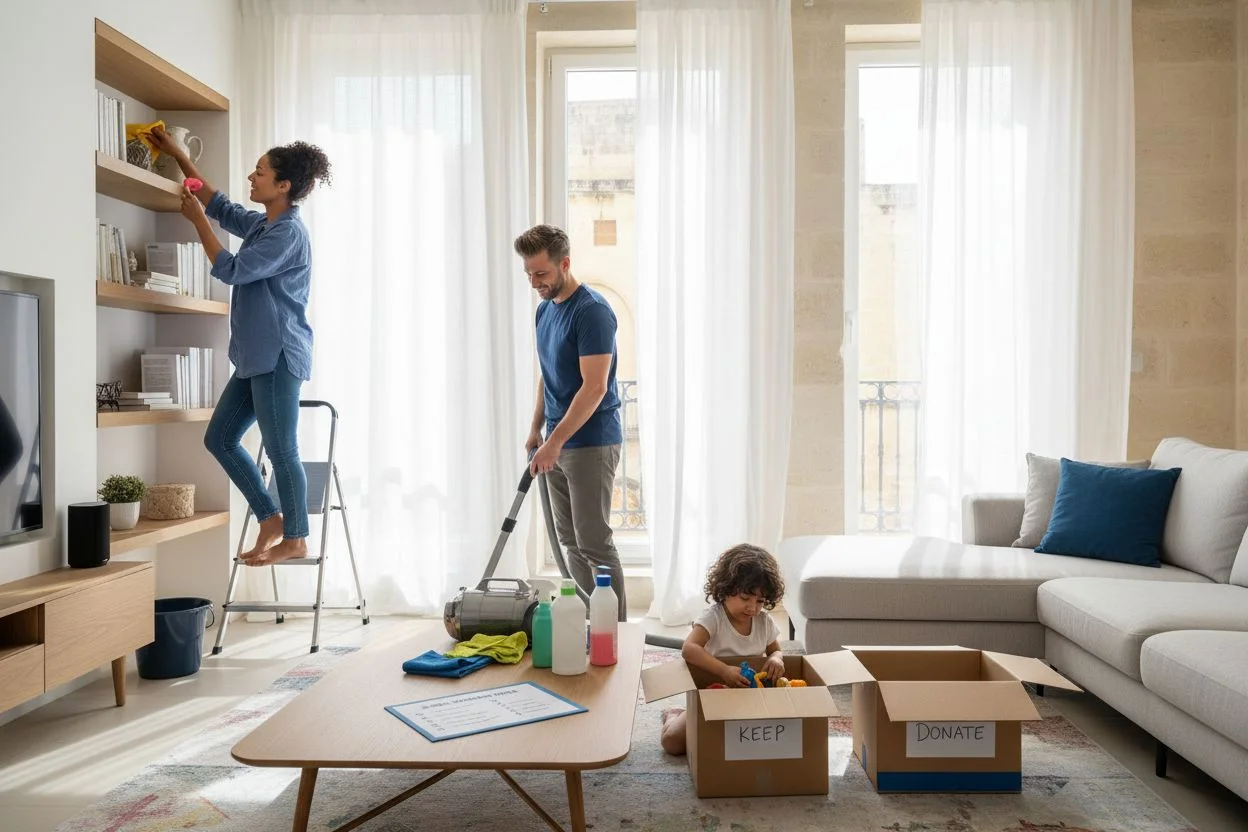
Start with realistic expectations
The biggest obstacle to maintaining a clean home isn't laziness — it's the gap between what magazines and social media suggest a clean home looks like and what's actually achievable. A home with children, pets, demanding jobs, and a full social life will never look like a show home on a Tuesday afternoon. That's not a failure; it's just normal life.
The more useful question isn't "how do I keep everything perfect?" but "what level of cleanliness do I actually need, and what's the most efficient way to get there?" Once you lower the benchmark from spotless to consistently decent, the whole task becomes less overwhelming.
It's also worth separating the idea of tidy from clean. A tidy home — things put away, surfaces clear — looks clean even when it isn't. A clean home — sanitised, dust-free, properly washed — can look cluttered and feel chaotic. In a busy household, keeping on top of tidiness does more for how the house feels day-to-day than any amount of deep cleaning.
Prioritise by use and visibility
Not every room in your home needs the same frequency of attention. A guest bedroom used once a month needs very different treatment from a kitchen used three times a day. Building your cleaning routine around actual usage rather than a generic template makes the work more manageable.
The rooms that tend to matter most in a busy household are:
- Kitchen — the most used room in most homes, and the one that can deteriorate most quickly if neglected. A quick wipe-down of surfaces after cooking each evening makes a disproportionate difference to how the room looks and feels.
- Bathrooms — high-use, prone to limescale and mould if left, and very noticeable when dirty. Even a five-minute clean of the sink, toilet and shower every two to three days is enough to stay ahead of most problems.
- High-traffic floors — hallways, kitchen floors and living room floors pick up the most dirt. Vacuuming these areas twice a week takes less time than most people expect.
Lower-priority areas — spare rooms, home offices that aren't regularly used, storage areas — can be addressed monthly or even less frequently without any real impact on how the home feels.
The value of small, consistent habits
The research on habit formation is fairly consistent: small actions repeated regularly are much more sustainable than large efforts done occasionally. Applied to cleaning, this means that doing five minutes of tidying every evening will have a bigger cumulative effect than spending four hours cleaning once a fortnight.
A few habits that tend to make a real difference:
- Deal with the kitchen before bed. Dishes done, surfaces wiped, bins not overflowing. Waking up to a clean kitchen is a better start to the day and prevents the depressing compounding effect of yesterday's mess still being there when today's cooking begins.
- Put things away immediately. The single biggest source of visible clutter is items left "for a moment" on surfaces, chairs, floors and stairs. The habit of returning things to their place immediately — rather than meaning to do it later — keeps rooms looking reasonable with almost no effort.
- Clean while you wait. The kitchen is full of two-minute waiting periods — while the kettle boils, while something heats up, while pasta cooks. These are natural cleaning windows. A quick wipe of the hob or a clean of the microwave takes less time than most people think when done little and often.
- Do one room properly each week. Rather than trying to clean the whole house every week (an approach that tends to result in nothing getting done properly), give one room your full attention each week on a rotating basis. Over four weeks, everything gets properly cleaned, and nothing is neglected for more than a month.
Products and equipment: keep it simple
The cleaning product market is enormous, and the variety available can make the whole task seem more complicated than it needs to be. In reality, most household cleaning jobs can be done effectively with a small number of products: a multi-surface cleaner, a bathroom cleaner that tackles limescale, a floor cleaner suited to your floors, washing-up liquid, and something for the toilet. That's essentially it.
Microfibre cloths, bought in multipacks, are more effective and more economical than paper towels or disposable wipes for most cleaning tasks. A decent vacuum cleaner with the right attachments saves more time and effort than most other pieces of equipment combined.
Having cleaning products stored near where they'll be used — bathroom products under the bathroom sink, kitchen products in a kitchen cupboard — removes a small but real barrier to actually using them. When everything is in one place on the other side of the house, there's always a reason to put it off.
"A home with children, pets, and a full life will never look like a show home. That's not a failure — it's just normal."
Where professional cleaning actually helps
For many busy households, bringing in a professional cleaner even once a fortnight can change the whole dynamic significantly. The way it tends to work is this: the professional clean brings the home back to a high baseline, and the day-to-day habits maintain it between visits. Without the professional baseline reset, habits alone often aren't enough to counteract the cumulative effects of daily life.
People often wonder whether hiring a cleaner is an indulgence. It's a legitimate question, and the honest answer is that it depends on your situation. If the alternative is spending your limited free time on cleaning rather than on rest, family, or things that matter more to you, the calculation looks rather different from a simple cost comparison.
It's also worth being clear about what a professional clean does and doesn't do. A regular home cleaning service maintains the current standard of the home — it keeps things clean. It doesn't replace the need for daily tidying, and it won't deal with deep-rooted issues like significant limescale build-up, mould, or areas that haven't been cleaned in months. For those, a deep clean is a more appropriate starting point.
Managing cleaning with children
Households with children face particular challenges. Children generate mess at a rate that can feel impossible to keep up with, and the energy required to manage both parenting and housework is substantial.
Some approaches that help:
- Involve children in age-appropriate cleaning tasks from an early age. This isn't about offloading labour — it's about building habits that will serve them well and reducing the sense that cleaning is purely your problem.
- Accept that certain areas of the home will be messier during certain life stages. A living room with young children playing in it will not look the same as one without. Working with this reality rather than against it reduces friction considerably.
- Focus evening tidying on shared spaces — kitchen, living room, hallway. Bedrooms can wait.
- Use the end of play as a natural tidying moment. Before a meal, before bath time, before bed — linking tidy-up time to existing transitions makes it easier to establish as a routine.
The seasonal reset
Twice a year — often in spring and before winter — it's worth doing a more thorough clean of areas that don't get attention in a regular routine. This includes things like cleaning behind appliances, washing curtains, descaling the kettle and coffee machine, cleaning the oven properly, and working through cupboards to clear out anything no longer needed.
This kind of seasonal reset is much easier to do if the day-to-day cleaning has been maintained in between. It's also easier to do all at once as a deliberate, scheduled effort rather than trying to fit it into normal life on an ad-hoc basis. Some households book a professional deep clean for this purpose, which is a practical solution if time is the main constraint.
A note on guilt
A genuinely messy or dirty home can affect mood, stress levels, and the sense that things are in control. That's real and worth taking seriously. But so is the tendency to hold unrealistic standards and feel guilty about falling short of them. Most homes are somewhere in between, and most people are doing a reasonable job given the constraints they're working with.
The goal is a home that works well for the people who live in it — comfortable, safe, and not a source of stress. That's achievable with consistent but realistic effort, and there's no single right way to get there.